|
|
| Course |
CEE 350 Environmental Pollution and Control
Face-to-Face Mode course
Call Number: 14148
3 Credits,
Fall Semester, 2026
Course Website: http://asellus.cee.odu.edu/epc/
|
| Session |
Spring Session #1 (August 24 - December 11, 2026) |
| Time/Days |
Tuesday & Thursday 3:00-4:15 PM (75 minutes) |
| Classroom |
OCNPS 100 (Oceanography Building)
|
| Prerequisite |
Foundations of Chemistry I (CHEM 121N/122N),
Calculus I (MATH 211) and
University Physics I (PHYS 231N)
|
| Instructors |
Jaewan Yoon, Associate Professor, CEE, KH130
E-mail:
<jyoon@odu.edu>
|
| Office Hours |
Tuesday 1:00-2:30 PM plus e-mail
|
| TA Information |
Ms. Sarah Tahajomi
[e-mail]
, CEE Gradate student
Homework Help Session:
Tuesday 1:00 - 2:30 PM
|
|
| |
-
This course is an introductory course to the
fundamental principles of Environmental
Engineering for Civil Engineering major students.
Goals of the class are to familiarize the
students with (intended & unintended) human activities that negatively impact the
environment and corresponding environmental engineering
techniques to mitigate and prevent such problems.
Topics to be discussed include:
- The concept of "System" and its mechanisms in flux, transport and fate,
- Introduction to common pollutants in environmental systems,
- Fate of pollutants in various environmental systems,
- Water quality management and modeling used in analysis and design,
- Introduction to water/wastewater treatment unit processes,
- Sources and transport of air pollutants,
- Air pollution control technology, and
- Solid/hazardous waste mitigation, remediation and management.
Emphasis will be equally on (must know) concepts and (how to) applications covering
broad areas such as physics, chemistry, biology, probability and statistics,
fluid mechanics that constitute environmental engineering systems and designs.
|
| |
-
Student Outcome SO2: An ability to apply the engineering design process to produce solutions that meet specified needs
with consideration for public health and safety, and global, cultural, social, environmental,
economic, and other factors as appropriate to the discipline:
- SO2-PI1:
Capable of applying the engineering design process
to produce solutions that meet specified needs
- SO2-PI2:
Capable of taking into consideration public health and safety
- SO2-PI3:
Capable of taking into consideration global, cultural,
social, environmental, economic, and other factors
in the engineering design process
|
| |
-
Following course textbook (required) will be
used for lectures, reviews and homework assignments.
|
CourseTextbook(required)
|
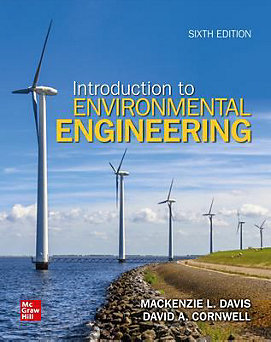
Introduction to Environmental Engineering, 6th Ed.,
Mackenzie Davis and David Cornwell,
McGraw-Hill, 2026
ISBN10: 1260241092 | ISBN13: 9781260241099
|
|
| |
-
- Please make a habit to closely stay with the course timeline.
We will be discussing a *lots* of topical areas and
related design methods, thus successful learning
for this course is absolutely
depending on a sound and persistent
time management strategy.
Once you are behind the course timeline, it would be
very difficult to catch up. Particularly, last-minute
cramming-up efforts just before exams had been
consistently turned out to be disastrous
in previous semesters.
- I expect an average student would spend about 0.5 hours of
study for reviewing each lecture.
This projection is primarily based on "a lot" of
topics the course will cover. (remember, this course is
an introductory course to Environmental engineering,
which is [in]famous for its broad spectrum of topics)
Class will introduces you [of CE major] to
essential elements of Enviromental Engineering [=EnvE]
since you'll definitely have to deal with many EnvE-related
issues in your future work, either directly or indirectly, as a
professional Civil Engineer.
- In case of questions, please come by/e-mail during
office hour (1:00-2:30 PM Tuesday) to discuss points that you do not understand
or simply want to discuss in more detail.
Along with office hours,
additional 1-to-1 (or e-mail) "Help Session" is also available
by the grader on Tuesday 1:00-2:30 PM.
If you're having a difficulty in your
homework, do take an advantage of this "Help Session."
- Homeworks assigned right after Thursday class
are due (i.e., upload your solution in PDF to Canvas/Assignment)
in the beginning of
coming Thursday class (i.e., 1 week cycle).
If you finished your homework earlier (yes!), no need to wait till
coming Thursday due deadline -- you can upload yours earlier to Canvas/Assignment anytime.
- ** Late homework will still be accepted after the due date
with a 70% pre-deduction
- Your homwork will be (normally) graded by following Monday afternoon,
and you can see comments and corrections, if any, in Canvas/Grades.
- Accommodations are provided for students with needs.
Students should contact the instructor
with applicable forms as early in the semester as possible.
|
| |
-
| Homeworks |
25% |
Nine (or Ten) homeworks in total,
Each dues by the begining of
Thursday class, i.e., one-week cycle
|
| Test #1 |
25% |
Full class period, 75-min, closed book & note |
| Test #2 |
25% |
Full class period, 75-min, closed book & note |
| Final Exam |
25% |
Full class period, 75-min, closed book & note |
| Total |
100% |
|
| Field Trip to a Local Water Treatment Plant (WTP) |
(5%) |
Extra credit, organized by Dr. Yoon,
Friday 1:00-2:30 PM -- Field trip is optional, not mandatory to participate in |
| Field Trip to a Local
Wastewater Treatment Plant (WWTP) |
(5%) |
Extra credit, organized by Dr. Yoon,
on Friday 1:00-2:30 PM -- Field trip is optional, not mandatory to participate in |
| Max. Attainable Total |
110% |
|
 |
Honor System
|
-
The Old Dominion University Honor Code applies to all works
associated with this course.
Academia is all about pride and
respect,
and the Honor Code is the heart of it.
Any deliberate plagiarism by copying and sharing the work of other(s) will
result in an automatic failure in this course and *beyond*.
Please hand-write and sign the ODU Honor Code - "
I pledge to ODU Honor Code" at the
top of the first page of all your homework assignments that
you are turning in. (first page only, no need to repeat in other pages)
Homework without the Honor Code pledge will receive
ZERO point, period.
|
Final Grade Assignment
|
-
|
Letter grades will be based on brackets (see right) out
of the 100% total.
For example, in the 100-90% bracket, equal or
greater than 95% will be A,
then A-. For other brackets, equal or greater than *7/100 will get +,
between *3/100 and *0/100 will get -.
A cumulative total equals
to 70 percentile or greater will guarantee you a grade of C- or
better. A cumulative total smaller than 60 percentile will equally
guarantee you a grade of F.
No "grading based on the curve" will be
applied in this course.
|
|
| 100%-95% |
A |
| < 95%-90% |
A- |
| < 90%-87% |
B+ |
| < 87%-83% |
B |
| < 83%-80% |
B- |
| < 80%-77% |
C+ |
| < 77%-73% |
C |
| < 73%-70% |
C- |
| < 70%-67% |
D+ |
| < 67%-63% |
D |
| < 63%-60% |
D- |
| < 60% |
F |
|
|
Grading Criteria
|
-
|
For example, a typical problem soution (in homeworks and exams),
which let's say worth total of 10 points, would be graded using the following criteria;
|
-
| Technical solution
(8 points total or 80%/100%) |
Points |
| Completely correct, crystal-clear and self-explanatory
|
8 |
| Approach is o.k., but a wrong answer/conclusion, a.k.a.,
a computational error or/and an unit conversion meltdown situation
|
6 |
| Reasonable attempt (yup, it shows), but plagued by serious error(s)
|
4 |
| Perfunctory and incomplete,
however still trying to show that you were
trying
|
2 |
| Problem not attempted
|
0 |
| Given answer(s) alone is correct by itself yet completely
irrelevant and superfluous
so that the answer has nothing to do with the solution
asked/required by the question
|
-2 |
| Does not appear to be written by an engineering major |
-4 |
|
| Presentation of your
solution
(2 point total or 20%/100%) |
Points |
| Neatly and succinctly illustrates one's thought process and rationale
behind procedures applied (which can be correct or incorrect)
|
2 |
| Dead Sea Scrolls quality, yet still theoritically
decipherable/traceable with darn good efforts
|
0.5 |
| Causes a throbbing migraine headache, illegible
|
0 |
| Does not appear to be written by an engineering major
|
-2 |
| Does not appear to be written by a college student |
-4 |
|
- UNITS should be clearly carried over throughout your solution
to provide the much-needed clarity and verification. (you are in Engineering major!)
Grave omission of UNITS will lead to corresponding deductions.
- Your solution will contain two critical components --
- Demonstration of procedural and computational correctness and
- (Summary of) correct final answer(s) to your design objective
that was asked by the problem statement or design directives.
(this is the official design instruction that you will provide to the contractors)
Thus reflecting above two critical components in your solution,
if you have any error in your procedure/computation,
deduction(s) will be applied.
In addition, subsequent (incorrect) final answer(s) will be deducted again.
This is not a double-taxing of points.
Instead, your final answer represents the final, as-built design information
that will be used in actual implementation/construction by contractors, it now contains
a legal liability (beyond procedural correctness in design & computation procedures).
Yes, that critical -- Be serious about your final answer (and the summary, to be used by contractors).
|
More on Grading
|
-
- Problems should be worked neatly. Show
your work thoroughly so that I could give partial credits
if applicable. Please write legibly on "one side of
the sheet" only.
- In your homework, make it sure to summarize your final answer(s)
at the end of each problem solution. Also, if you used a
spreadsheet program (i.e., Excel, etc.) to repeatedly solve the problem,
show at least one sample calculation procedure done by hand.
- All exams will be
written exams and will be over a full class period
(75 minutes). All exams will
be closed book, closed note exams -- get your hand-calculator ready,
seriously.
- For each exam,
all necessary equations, formulae and tables will be
provided with the exam. However, you still need to familiarize
yourself with these equations and formulae since no
description/unit for parameters/coefficients will be given.
(you got to know what you are doing)
- I'll do my best to promptly grade your homeworks and exams.
It is possible that you may experience some delay
depending on the size of class. Average number of students for
this class has been close to 30 over years.
Graded homeworks are posted to Canvas.
Please do make a habit to review your graded homework --
will definitelly help you in preparing for exams.
Once graded, your cumulative grade will be posted on the
class website
as soon as the grading is done per assignment/exam.
Check your latest grade frequently,
and report to me immediately when you find any discrepancy in your grade.
- If you believe your exam(s) was incorrectly graded
for some reason, please report to me with a detailed explanation.
I reserve the right to completely regrade homework(s)/exam(s) that
has been requested. (Regraded result can be either better or worse
than the original grade).
|
|
| |
CEE 350 Environmental Pollution and Control
3 Credits, Fall Semester, 2026
CRN: 14148 (Face-to-Face)
Session #1 (August 24 - December 11, 2026)
Tuesday & Thursday 3:00-4:15 PM (75 minutes) at OCNPS 100 (Oceanography Building)
Today is
|
Important Dates to Remember |
| Test #1 |
October 6 (Tuesday, Full class period, 75-min, closed book & note) at OCNPS 100
|
| Filed Trip #1 |
October 30 (Friday 1:00-2:30 PM),
City of Norfolk Moore's Bridges Water Treatment Plant (MBWTP), 1:00-2:30 PM, 90-min.
Extra credit (5%), Field trip is optional, not mandatory
|
| Filed Trip #2 |
November 6 (Friday 1:00-2:30 PM),
Hampton Roads Sanitation District (HRSD) VIP Wastewater Treatment Plant (WWTP),
City of Norfolk, Extra credit (5%), Field trip is optional, not mandatory
|
| Test #2 |
November 10 (Tuesday, Full class period, 75-min, closed book & note) at OCNPS 100
|
| Final Exam |
December 5 (Saturday, 3:45-5:00 PM, 75-min, closed book & note) at OCNPS 100
|
|
| Period |
Lecture |
Topics |
Chapter Reading |
| Aug. 25 (T) |
1 |
Introduction & Course Overview
|
1 |
| Aug. 27 (R) |
2 |
Mass and Energy Balance
|
2 |
| Sept. 1 (T) |
3 |
Hydrological Cycle, Water Sources, Uses and Properties
|
4 |
| Sept. 3 (R) |
4 |
Physical Water Quality Parameters
|
4,7 |
| Sept. 8 (T) |
5 |
Biological Water Quality Parameters,
and Indicator organisms
|
4,7 |
| Sept. 10 (R) |
6 |
Determination of Solute Concentration
|
5-2 |
| Sept. 15 (T) |
7 |
Precipitation Reaction
|
5-3 |
| Sept. 17 (R) |
8 |
Acid/Base Chemistry, Carbonate Buffer,
Alkalinity and Hardness
|
5-3, 5-4 |
| Sept. 22 (T) |
9 |
Reaction Kinetics
|
5-5 |
| Sept. 24 (R) |
10 |
Flow Models, Transport Processes and
Mass Flux of pollutants
|
2 |
| Sept. 29 (T) |
11 |
Introduction to Water Quality Management
|
7 |
| Oct. 1 (R) |
12 |
DO and BOD in Natural Systems
Streeter-Phelps DO Sag Model
|
7 |
| Oct. 6 (T) |
* |
Test #1 (Full class period, 75-min, closed book & note) at OCNPS 100
|
 |
| Oct. 8 (R) |
13 |
Introduction to Water Treatment Processes
|
6-1 |
| Oct. 13 (T) |
* |
No Class
(Fall Holiday, Oct. 10-13, Sa-T)
|
 |
| Oct. 15 (R) |
14 |
Coagulation and Flocculation
|
6-2, 6-4 |
| Oct. 20 (T) |
15 |
Lime and Soda Softening
|
6-3 |
| Oct. 22 (R) |
16 |
Settling and Sedimentation
|
6-5 |
| Oct. 27 (T) |
17 |
Rapid Sand and Multimedia Filtration, and Disinfection
|
6-6, 6-7 |
| Oct. 29 (R) |
18 |
Introduction to Wastewater Treatment Processes,
Primary Wastewater Treatment System
|
8 |
| Oct. 30 (F) |
* |
Field Trip #1
to City of Norfolk Moore's Bridges Water Treatment Plant (MBWTP),
1:00-2:30 PM, 90-min.
Optional, not mandatory to participate in
|
|
| Nov. 3 (T) |
* |
No Class
(Election Day Holiday)
|
|
| Nov. 5 (R) |
19 |
Secondary Wastewater Treatment System, and
Activated Sludge Process
|
8 |
| Nov. 6 (F) |
* |
Field Trip #2
to Hampton Roads Sanitation District (HRSD) VIP Wastewater Treatment Plant (WWTP),
1:00-2:30 PM, 90-min.
Optional, not mandatory to participate in
|
|
| Nov. 10 (T) |
* |
Test #2 (Full class period, 75-min, closed book & note) at OCNPS 100
|
|
| Nov. 12 (R) |
20 |
Air Pollution Phenomena, Greenhouse Effect,
and NAAQS Standards
|
9 |
| Nov. 17 (T) |
21 |
Atmospheric Stability and Lapse Rates
|
9 |
| Nov. 19 (R) |
22 |
Gaussian Dispersion Modeling of Air Pollutants
|
9, 9-8 |
| Nov. 24 (T) |
23 |
Air Pollution Control Devices
|
9-10 |
| Nov. 26 (R) |
* |
No Class
(Thanksgiving Holiday, Nov. 25-29, W-S)
|
|
| Dec. 1 (T) |
24 |
Solid Waste Management
|
9 |
| Dec. 3 (R) |
25 |
Hazardous Waste Management
|
12 |
| Dec. 5 (Sa) |
* |
Final Exam (3:45-5:00 PM, 75-min, closed book & note) at OCNPS 100
|
|
|
|

|
|
|