| |
 |
|

|



|
|
| Course |
CEE 755/855 Water Quality Management
Lecture 3 hours; 3 credits,
Fall Semester, 2024
(offered at ODU Campus and Distance Learning sites)
Course Website: http://asellus.cee.odu.edu/wqmg/
-
CALL No.: 21671
CEE 755 - ODU Main Campus, GORNTO 215
CALL No.: 21672
CEE 755 - WC2_Hampton Roads
CALL No.: 21673
CEE 755 - WC5_In Virginia
CALL No.: 21674
CEE 755 - WC7_Outside Virginia
CALL No.: 21675
CEE 855 - ODU Main Campus, GORNTO 215
CALL No.: 21676
CEE 855 - WC2_Hampton Roads
CALL No.: 21677
CEE 855 - WC5_In Virginia
CALL No.: 21678
CEE 855 - WC7_Outside Virginia
|
| Session |
Fall Session #1: August 24 through December 6, 2024
|
| Day/Time |
Monday, 7:25-10:05 PM |
| Classroom |
Gornto Distance Learning building 215, GORNTO 215 and Online |
| Prerequisite |
Graduate standing minimum. Prerequisites:
(CEE 350 (Env. Pollution and Control) and
MATH 307U (ODE)) or Permission of
the instructor. Students are expected to have a good background in
mathematics and computing.
|
| Instructor |
Jaewan Yoon, Associate Professor, CEE,
KH (Kaufman Hall) 130 |
| Phone |
(757) 683-4724 |
| e-mail |
jyoon@odu.edu
|
| Office Hours |
2:00-4:00 PM M; Open and Extensive,
both in-person and via e-mails.
|
|
| |
-
System, Reproducibility and Scalability
Characterization of water quality in various natural
ambient system domains in micro-, meso- and macro-scales,
and human activities and/or natural contaminant inputs
that trigger responses in these systems will be discussed
in the class.
Subsequent engineering management practices and methodologies,
both in analysis and design orientatins, and related
water quality-related laws and regularions,
with particular emphases on TMDL (Total Maximum
Daily Load) and WLA (Waste Load Allocation)
approaches to minimize contaminant inputs
and for restoring water quality at the system level
will be the main topics.
Physical, chemical, biological, and hydrological
trigger-response relationship in surface water system domains
in junction with water quality management strategies
will be expanded in the second half of the class.
Reaction kinetics, material balances and componental system
equations will be introduced in modeling contaminant transport,
fate and flux in the environment.
Specific attention will be given to typical water quality
problem domains in stream and river systems, lake and
reservoir systems.
Students are expected to have stable background knowledge
in hydralics/hydrology, chemistry, physics, biology and computation methods.
This CEE 755 Water Quality Management (=understanding WQ Systems)
is the first sequence course to
CEE 756 Water Quality Modeling (=applications of WQ Analysis and Design) course.
|
| |
-
Following course textbook (required) will be
used for lectures and homework assignments.
|
Course Textbook (required)
|
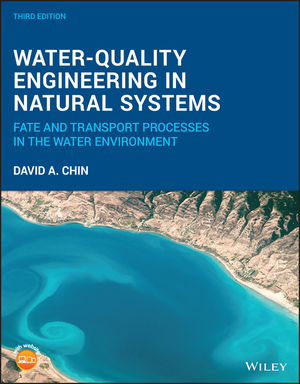
Water-Quality Engineering in Natural Systems: Fate and Transport
Processes in the Water Environment 3rdd Edition,
Chin, David A., 2021,
Wiley, ISBN 978-1-119-53208-8
|
|
| |
-
- Chemical, physical, and biological characteristics of aquatic system
- Ecological principles impacting water quality
- Hydrologic and hydraulic principles relating to water-quality monitoring and modeling
- Substance kinetics, reactions, transport and fate phenomena plus FLUX!!
- Quantitative characterization of assimilative capacity of aquatic systems
- Various pollution constituents - point, nonpoint, diffused, surface-subsurface interaction
- Assessment, remediation, planning and management, and post-audit/monitoring strategies
- Eutrophication process and trophic state indices
- Treatment methods: aeration, nutrient inactivation, biological manipulation, etc.
- State and Federal water-quality legislation, law and permits; standards and criteria
- WQ Domain: Stream and River; Uni-directional source and sink
- WQ Domain: Lake and Reservoir; Vertical stratification and destratification: influences on water quality
|
| |
-
- The classroom presentation will be lecture and discussion
even though the class will be primarily in Distance Learning & broadcast setting.
I would ask questions during lectures to promote discussion
of various topics and to stimulate thoughts. Feel free to
interrupt me at any time in order to discuss points that
you do not understand or simply want to discuss in more
detail. (of course, at the same time we need to use
the time wisely to cover class topics)
- Office Hours:
You're welcome to drop by for a discussion. Or if you prefer,
you would e-mail me at
<jyoon@odu.edu> to ask question(s), with a better clarity.
Please come prepared with
some explicit questions which demonstrate that you have
done some thinking about your 'lingering' problem on your own. You must
have some knowledge to ascertain what it is you don't understand.
|
| |
-
| Project |
50% |
Final report and a Presentation
by each project group |
| Midterm Exam |
20% |
Takehome Exam, Closed book and notes |
| Final Exam |
30% |
Takehome Final, Open book and notes |
|
|
|
| Total |
100% |
|
Homeworks are not assigned but non-gradable, guilt-free weekly
exercise questions will be posted
to Canvas/Assignments, followed by a solution one week later.
If you'd registered this course as CEE 855, in addition to "all above,"
you are required to submit a term research paper (due together with your
Final Project Report). Topic of the term research paper will be identified
after a short meeting with the instructor in the beginning of the semester.
 |
Final Letter Grade Assignment
|
-
|
Final letter grades will be based on brackets (see right side) out
of 100% total. For example, a cumulative total equals
to a 65 percentile or higher will guarantee you a grade of C- or
better.
|
|
| 100%-93% |
A |
| < 93%-88% |
A- |
| < 88%-85% |
B+ |
| < 85%-80% |
B |
| < 80%-78% |
B- |
| < 78%-75% |
C+ |
| < 75%-70% |
C |
| < 70%-65% |
C- |
| < 65% |
F |
|
|
Class Logistics
|
-
- Both Miterm and Final Exams will be Takehome exams.
Midterm exam will be a closed book and notes, and
Final Exam will be an open book and notes exam.
(Final exam will cover topics discussed
after the Midterm exam)
Be sure to handwrite the Old Dominion University Honor Code
in your cover page of exams and sign.
Problems should be worked neatly and
briefly on 8.5"x11" engineering ruled pads (or equivalent),
with the pages stapled and numbered. Show all your works so I
can give proper credits. Please write legibly on "one
side of the paper" only.
- A requirement of this course is to conduct a class
project on a water quality management/modeling/planning problem/design with a
20~25-minute (which will be depending on the class size)
presentation and submit a written final report.
The project will be a group effort, ideally two students
per group, three students max. For more information, please see
the Class Project Guideline page
- Reasonable accommodations will be provided for students with disabilities.
Please let me know as early in the semester as possible.
- If you think your exam was incorrectly graded or
graded too harshly, please return it to me with an
explanation. I reserve the right to completely regrade
an examination that has been returned (regraded
result can be either better or worse than the original grade).
|
|
Honor Code
|
-
The Old Dominion University Honor Code applies to all works associated with this course.
Honor the Honor Code. Remember, the academia is all about
pride and
respect, and the
Honor Code is the heart of it.
|
| |
CEE 755/855 Water Quality Management
Lecture 3 hours; 3 credits, Fall Semester, 2024
CALL No.: 21671/21672/21673/21674 CEE 755 & 21675/21676/21677/21678 CEE 855
Fall Session #1 Aug 24-Dec 6, 2024
Monday, 7:25-10:05 PM
GORNTO 215 and Online
Today is
-
Important Due Dates to Remember
| 1-page Project Proposal Due |
Sept. 30 (Monday) |
| Midterm Exam
(Closed book & notes)
|
Distributed: Oct. 14 (Monday) 7:00 PM
Due by: Oct. 16 (Wednesday) 5:00 PM or earlier to Canvas/Assignments
|
| Project Progress Report Due |
Nov. 4 (Monday) |
| E-mail Your Group's One-page Project Presentation Summary to Dr. Yoon |
Nov. 29 (Friday) 5:00 PM |
| Project Presentation |
Dec. 2 (Monday) via Zoom |
| Project Final Report & Project Presentation (in .pptx) Due |
No later than Wednesday Dec. 4 5:00 PM to Canvas/Assignments |
| Final Exam
(Open book & notes)
|
Distributed: Dec. 9 (Monday) 7:00 PM
Due by: Dec. 10 (Tuesday) 5:00 PM or earlier to Canvas/Assignments
|
|
| Period |
Date |
|
Topics |
Read Chapter(s) |
| 1 |
Aug. 26 |
M |
- Introduction & Course Overview
- Sources and Uses of Water
- Water Quality Standards
|
1 |
| 2 |
Sept. 2 |
M |
|
|
| 3 |
Sept. 9 |
M |
- Physical Characteristics of Water
- Chemical Characteristics of Water
- Biological Characteristics of Water
- Bacteria Source Tracking (BST) in TMDL
|
2 |
| 4 |
Sept. 16 |
M |
- Water Quality Standards (WQS) in Federal and State Levels
- Environmental Impact Assessment (EIA)
- Water Quality in the EIA process
- Decision Matrix
- Tradeoff Analysis
|
Lecture Note & 6 |
| 5 |
Sept. 23 |
M |
- Material Balances of Flow and Concentration
- Mass Flux:
- Advective
- Diffusive
- Dispersive
- Reactive
|
3 |
| 6 |
Sept. 30 |
M |
- Contaminant Movement/Transport in Various Environments
- Types and Common Indicators of Pollution
|
Lecture note, 2 & 3 |
| 7 |
Oct. 7 |
M |
- Environmental Laws and Regulations
- Pollution Control Laws
- Planning and Management
- Post-Audit/Monitoring aspects of Water Quality
|
Lecture note, 4.8 & 7.6 |
| 8 |
Oct. 14 |
M |
No Class -- Fall Holiday, Oct 12-15 (Sa-T)
- Takehome Midterm
(closed book & notes)
Midterm material will be posted to Canvas/Assignments on
Oct. 14 (Monday) at 7:00 PM.
Midterm exam is due by Oct. 16 (Wednesday) 5:00 PM
or ealier at Canvas/Assignments.
|
|
| 9 |
Oct. 21 |
M |
- Tools for Water Quality Management:
- Mathematical Models
- Regulatory Models
|
Lecture note plus 4.4-4.6 & 7.5 |
| 10 |
Oct. 28 |
M |
- Water Quality in Rivers - I
- Characteristics
- Assessment
- Management Strategy
- Models
- TMDL & WLA
|
3, 4 & 7 |
| 11 |
Nov. 4 |
M |
- Water Quality in Rivers - II
- Characteristics
- Assessment
- Management Strategy
- Models
- TMDL & WLA
- Due: Project Progress Report
|
3, 4, 7 |
| 12 |
Nov. 11 |
M |
- Water Quality in Estuaries
- Characteristics
- Assessment
- Management Strategy
- Models
- TMDL & WLA
|
3, 7 & 9 |
| 13 |
Nov. 18 |
M |
- Water Quality in Lakes/Reservoirs - I
- Characteristics
- Assessment
- Management Strategy
|
3, 7 & 9 |
| 14 |
Nov. 25 |
M |
- Water Quality in Lakes/Reservoirs - II
- Models
- TMDL & WLA
|
3, 7 & 9 |
| * |
Nov. 29 |
F |
-
E-mail one-page summary of your
group's project presentation to
Dr. Yoon
no later than 5:00 PM.
For more information, please see
|
 |
| 15 |
Dec. 2 |
M |
-
Project Presentations
(via Zoom)
|
|
| 16 |
Dec. 4 |
W |
Due: Project Final Report
and Project Presentation (in .pptx)
to Canvas/Assignments no later than
Wednesday December 4 5:00 PM.
|
|
| * |
Dec. 9 |
M |
-
Final Exam
material will be posted to Canvas/Assignments at 7:00 PM.
Final exam is due by Dec. 10 (Tuesday) 5:00 PM or earlier at Canvas/Assignments.
Final exam (open book/notes) will cover topics
discussed after the Midterm exam.
|
|
|
|
|
|
|
|